


We build custom AI systems for a living, so you'd expect this post to conclude "always build." It won't — because we've watched companies burn money on both sides of this decision, and the failure pattern is identical: choosing based on instinct instead of a framework. Here's the one we use, including the cases where the right answer is a SaaS subscription and not us.
Build vs buy AI: an honest framework from people who build for a living

Buy when the problem is generic
If your need is one that thousands of companies share in nearly identical form — transcribing meetings, drafting marketing copy, basic chat support deflection — buy. Vendors serving that entire market will out-iterate any custom build, the switching costs are low, and your version of the problem isn't special enough to justify owning code. The honest test: if you can describe your requirement without mentioning your own systems, data, or workflow, an off-the-shelf product probably exists and probably wins.
Build when the value lives in your specifics
Custom earns its cost in three situations, and they share a theme: the value comes from your context, which no vendor can package.
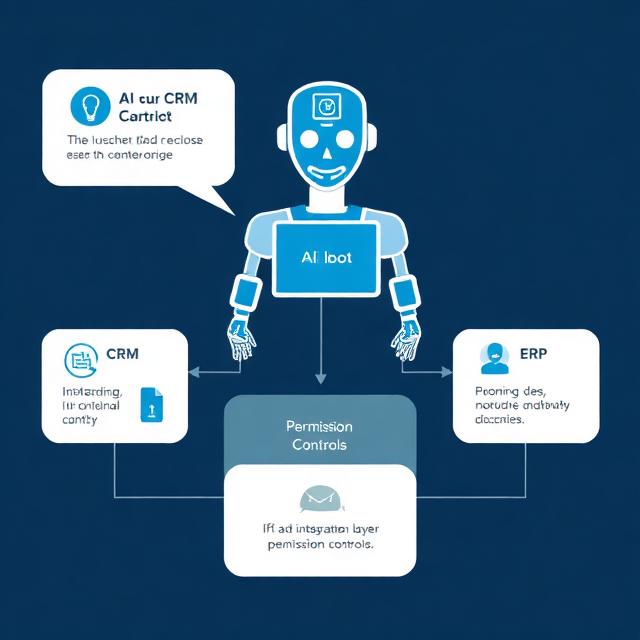
- Deep integration.The AI needs to read from and write to your ERP, your CRM, your internal tools — with your business rules governing what happens. Off-the-shelf tools integrate at the shallow end; when the workflow is the value, generic integrations leave most of it on the table.
- Proprietary data as advantage. If your differentiation is your data — pricing history, domain documents, operational patterns — then an AI system built around that data is a competitive asset. Feeding the same data into a shared SaaS tool gives you the same capability as every competitor who does likewise.
- The workflow is the product.When AI capability is going into something you sell or a process that defines you operationally, renting it means your roadmap belongs to someone else's product team.
The hybrid most people miss
The strongest pattern we deploy isn't pure build: it's custom orchestration over commodity components. Foundation models via API, established vector databases, proven frameworks — with custom engineering exactly where your value is: the integration layer, the domain logic, the evaluation harness, the workflow. Nobody should train a model from scratch to answer that; almost everybody with a real integration problem needs more than a SaaS checkbox. The build vs buy question is rarely binary — it's about choosing which layer deserves custom investment.
The costs both sides undercount
Buying looks cheap until you count per-seat pricing at scale, the workflow contortions to fit the tool, and the data you're feeding into a shared platform. Building looks expensive until you count what shipping the exact workflow is worth — but it carries real obligations too: you own the maintenance, the model migrations, the monitoring. We've written honestly about what AI implementation actually costs; the summary is that build costs are mostly determined by scope clarity and data readiness, not by ambition.
A decision checklist
Buy if: the problem is generic, integration needs are shallow, you need it live this month, and switching later is cheap. Build if: the workflow touches multiple internal systems, your data is the advantage, the capability is core to how you compete, and you can define a measurable v1. Hybrid if — as is usually true — some layers are commodity and one layer is genuinely yours.
If you're weighing this decision for a specific workflow, that's a conversation worth having before either purchase order — our AI development team scopes exactly this question, and our dedicated teams embed with yours when the answer is build. And when the honest answer is "buy the tool," we'll tell you that too — it's cheaper for everyone than a custom project that shouldn't exist.
Manual vs automated testing: which does your project actually need?

Can AI agents integrate with your existing ERP or CRM systems?
Integrating AI chatbots with your CRM and ERP: the part that decides everything

RAG implementation: what the tutorials skip and production teaches
