




Quality from day one.
Automation that grew with the product. How we built a complete QE practice from zero — and evolved it through a Cypress-to-Playwright migration as HelixIntel scaled into AI, fleet management, and insurance partnerships.
Automated tests
Test cases built
Peak quarter executions
Peak closure rate
Full-cycle quality engineering for a facilities intelligence platform.
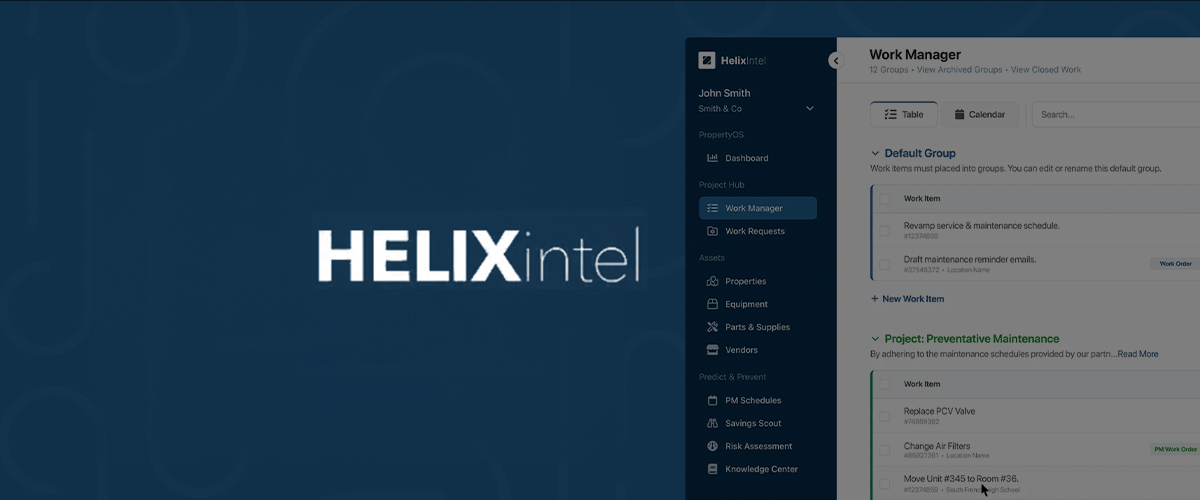
HelixIntel is a facilities and maintenance intelligence platform serving maintenance professionals and insurance partners. Its flagship product, HelixCMMS, is a centralised PropertyOS™ for managing work orders, preventive maintenance, asset tracking, team management, reservations, and template libraries — across web and native iOS / Android apps. The platform also serves insurance carriers, pools, and programmes through HelixPrevent, a predict-and-prevent suite that turns policyholder maintenance activity into measurable risk reduction.
HelixIntel clients report up to 60% fewer claims and documented 10×+ ROI, with SOC 2 compliance and trust from leading insurance organisations across the United States. As the product grew — AI chatbot functionality, fleet management, deeper insurance integrations — quality engineering has been a constant across every release cycle. We were brought in to build that QE capability from nothing: process, documentation, and automation, all from scratch, in a product environment that demanded daily end-to-end execution to stay reliable.
Four problems to solve at once.
When the QE team joined HelixIntel, there was no existing quality engineering process, no test documentation, and no automation coverage. The team was brought in to build everything from scratch — in a product environment that required daily end-to-end test execution to maintain reliability. The brief was simple to state and hard to deliver: stand up a complete QE practice from zero, keep daily releases stable, and grow coverage as the product expands.
No documentation, no test assets
There were no test cases, feature matrix, or testing documentation of any kind. Everything had to be built through active client collaboration u2014 gathering requirements, reverse-engineering flows, and building coverage from the ground up.
Daily E2E execution required
The client needed end-to-end tests executed every day to maintain stability. Manual execution of all E2E flows daily was unsustainable u2014 it consumed disproportionate effort and left no room for exploratory testing.
Multi-platform coverage
HelixIntel operates across web, iOS, and Android u2014 with different device configurations, screen sizes, and OS versions. Manual cross-platform testing was time-consuming and hard to scale without tooling support.
Rapidly expanding feature set
The product evolved continuously u2014 work manager enhancements, new PM schedule logic, automated workflows, AI chatbot capabilities, and fleet management. Testing had to adapt quickly without losing depth on existing flows.
A QE practice, built in layers.
Built test documentation from scratch
Through continuous client collaboration, the team created a comprehensive feature matrix and 600+ structured test cases covering all core workflows u2014 Work Manager, Work Requests, PM Schedule, Templates, Automated Workflows, Reservations, Asset Management, and Team Management. Test assets stayed current as the product evolved.
Daily E2E automation with Cypress
To address the manual execution burden, Cypress was introduced as the first automation tool. E2E flows were automated and scheduled for daily execution, generating detailed reports after each run u2014 giving the client reliable visibility into application health without manual effort.
Migration to Playwright with expanded coverage
As the product matured and the suite grew, all automation was migrated from Cypress to Playwright (TypeScript) u2014 a more powerful and maintainable framework. Existing scripts were migrated and new tests added for newer features, growing the suite to 80+ tests across a wider set of flows.
Mobile testing via BrowserStack
iOS and Android testing was integrated from an early stage using BrowserStack. Both the web app and native mobile applications were tested across real device configurations, catching device-specific defects in UI, authentication flows, and notification handling.
Consistent regression & feature testing
Beyond automation, the team maintained structured manual regression cycles across Work Manager, Templates, PM Schedule, Reservations, and Automated Workflows. New features u2014 AI chatbot, fleet management, app redesign u2014 received thorough exploratory and structured testing, with defects tracked to closure in ClickUp.
Built-in reporting & daily insights
During the Cypress phase, Mochawesome reports with video recordings were generated after every run. After migrating to Playwright, the built-in HTML reporter provided rich structured results natively. For manual testing, Jam and similar screen recorders capture and share defect evidence with developers.
Cypress → Playwright.
Automation at HelixIntel evolved deliberately. We introduced automation proactively to solve the daily manual execution burden, then invested in migrating and expanding the suite as the product grew — so automation kept pace with the application instead of falling behind it.
What the work delivered.
Daily execution burden eliminated
The daily manual testing requirement that consumed team capacity was solved through automation u2014 first with Cypress, then with a more powerful Playwright suite running 80+ scripts.
600+ structured test cases built from scratch
Comprehensive regression coverage across every core platform module u2014 a quality foundation that grows with each release.
Cypress u2192 Playwright migration completed in full
All existing scripts migrated, new tests added, resulting in a more maintainable and scalable automation suite.
Cross-platform mobile coverage established
iOS and Android behaviour validated on every release via BrowserStack u2014 catching device-specific defects in auth, UI, notifications, and file handling before users see them.
Peak 88% defect closure rate
Consistent defect detection across the engagement u2014 strong discovery quality and effective collaboration on resolution and retesting.
Coverage extended into every new product area
AI chatbot testing, fleet management validation, app redesign regression, and insurance-partner features u2014 all absorbed into QE scope as HelixIntel expanded.